There is a pattern that repeats itself every time a major employment centre takes root in a city. The land around it, once unremarkable, quietly reprices. It happened to Kazhakkoottam. It happened to Sreekaryam. It happened to Akkulam. Each was a peripheral suburb with no particular claim on a homebuyer’s attention. Then Technopark arrived in phases, over decades and Trivandrum’s residential geography reorganised itself around 84,000 jobs.
That pattern is now playing out roughly 15 kilometres north of the original campus, at a stretch of the NH Bypass most Trivandrum residents still associate with paddy fields. The location is Pallippuram. The catalyst is Technopark Phase 4 officially called Technocity. For a data-driven investor watching this market, the question is not whether the pattern will repeat. The question is how far along the cycle you are when you decide to act.
Section 1: What Technopark Phase 4 Actually Is
Technopark in its current form is already a significant economic ecosystem. It covers 768 acres across Phases 1 through 3, hosts over 540 companies, and supports a daily workforce that exceeds 84,000 professionals operating within 13 million square feet of developed workspace. By any measure, it is the single largest driver of skilled employment in Kerala’s capital.
Phase 4 or Technocity extends the footprint by a further 389.74 acres across Pallippuram and Mangalapuram, to the north of the existing campus. What makes this phase structurally different from its predecessors is the density of anchor institutions that have committed to it. These are not speculative developments waiting on tenants. Several are already operational or under advanced construction.
- Digital University Kerala – India’s first dedicated digital university, a permanent generator of tech talent and research activity.
- Kerala Space Park (K-Space) – ISRO adjacent space-tech corridor; attracts highly specialised, high-income workforce.
- TCS Phase 4 Campus – One of TCS’s largest India campuses; significant employment scale in a single anchor.
- Brigade World Trade Center – Grade A commercial inventory from a Tier 1 developer signals institutional confidence in the corridor.
- Digital Science Park – Research and incubation hub linked to the Digital University ecosystem.
- KINFRA Unity Mall – Retail and commercial anchor converts a work campus into a live-work-retail zone.
- Taurus Zentrum Mall – Planned as India’s largest mall by leasable area; a regional retail gravity event.
On the employment side, approximately 4 million square feet of office and tech space is currently under active development within Technocity. Industry estimates peg near-term job creation from this tranche alone at over 30,000 positions. Projections that account for the full buildout of the campus put the long-term employment potential above 1 lakh jobs, a number that, if realised over the next decade, would roughly double Technopark’s current workforce.
Section 2: The Residential Demand Chain – How Job Creation Becomes Housing Pressure
The mechanism by which IT employment translates into residential demand is well understood in Bangalore, Hyderabad, and increasingly Kochi. In Trivandrum, it is still underestimated by investors who filter the city out because of its slower historical pace.
The chain works in four stages. First, a significant employer commits at scale already done at Technocity through TCS, ISRO’s K-Space collaboration, Digital University, and the arriving MNCs. Second, the mid-career professional tier of that workforce begins seeking quality residential options within commute range. For Technocity, that radius is the NH Bypass corridor: Pallippuram, Mangalapuram, Menamkulam, and Kulathoor.
Third, rental demand tightens faster than new supply can materialise. Developers respond, but the construction lag is 24 to 36 months. Early-stage residential projects in the demand zone, particularly those close to possession command a pricing advantage during this window. Fourth, as retail and social infrastructure arrive, the micro-market transitions from rental driven to ownership driven. Capital values reset upward, and investors who entered during the buildup phase benefit from both rental yield and capital appreciation. Trivandrum is in stage two transitioning to stage three. The employment is real and growing. Housing supply at Pallippuram remains thin relative to incoming demand.
Section 3: The Micro-Markets in the Demand Zone
Not every location on the NH Bypass benefits equally. Distance from the campus gates matters.
Pallippuram is the primary demand zone immediately adjacent to Technocity, within the 400-acre campus boundary. Commute time for Technocity employees is essentially eliminated. This is the micro-market with the tightest supply-demand imbalance and the strongest rental yield fundamentals.
Mangalapuram is the secondary anchor, at the gateway junction of Technocity and already seeing commercial activity from the institutional presence nearby.
Menamkulam benefits from proximity to both Technocity and the established Phase 1 campus at Kazhakkoottam useful for a workforce that may work in either location over a career.
Kulathoor, south of Kazhakkoottam, represents the mature end of the corridor: higher prices, less upside. The sharpest opportunity sits at the north end, where Pallippuram’s supply is youngest and its employment anchor newest.
Section 4: Where Cordial Vivana Sits in This Picture
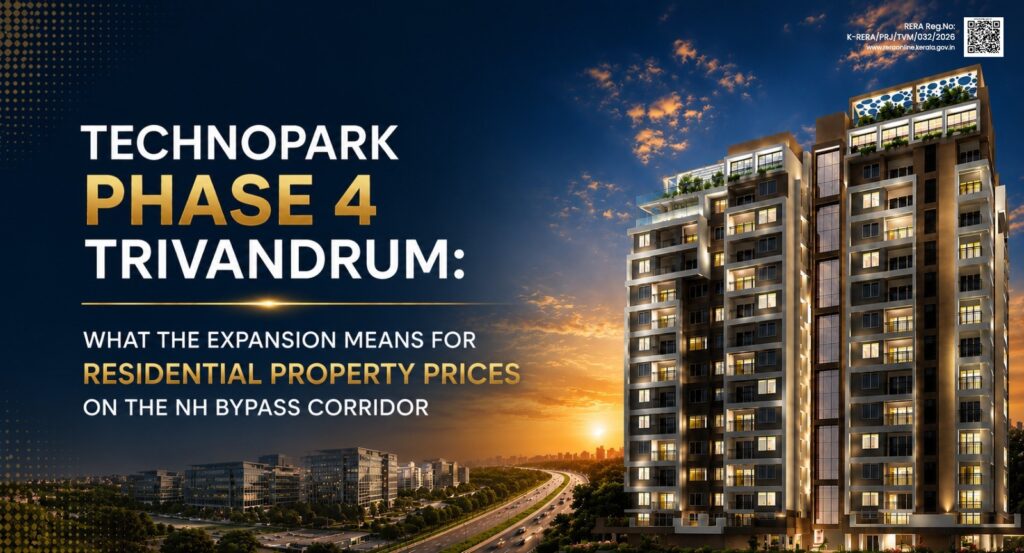
If the analysis above establishes Pallippuram as the primary demand absorption zone for Technocity employment, and if entry stage pricing is a meaningful part of the investment case, then the relevant question is what projects are currently available in that zone at pre possession prices and who is building them. Cordial Vivana is a super luxury residential project located at Pallippuram, on the NH Bypass, directly adjacent to the Technocity corridor. It is developed by Cordial Developers Pvt. Ltd., a Trivandrum-based company with over 45 years of construction history and 133+ completed projects, a track record that matters in a market where project delivery is a real variable.
The project offers 2 BHK, 2 BHK + Study, 3 BHK, and 4 BHK apartments, with bank approvals from SBI, HDFC, and Canara Bank already in place. On the amenity side, the specification is positioned for the professional demographic that Technocity will bring: co-working space and reading room, EV charging for every apartment, biometric access, three KONE/Johnson lifts, and a full lifestyle amenity stack including pool, gym, home theatre, and rooftop zone.
What is relevant from an investment standpoint is timing. The project is ongoing and currently at the pre-possession pricing stage. In Trivandrum’s Technopark adjacent micro markets, the clearest historical pricing inflection has occurred at possession when the unit becomes a tangible, occupiable asset and the discount for construction risk disappears from the market’s pricing model. Buyers who enter before that inflection have consistently accessed better entry points than those who wait for the project to complete.
The Pattern Runs on Time
Kazhakkoottam was a suburb. Then it became Technopark’s address. Today it is one of the most expensive residential corridors in Trivandrum, and investors who bought during the early phases of that transformation have little reason to regret their timing.
Pallippuram is at an earlier point on the same curve with a larger catalyst, a more diverse institutional base, and a supply of quality residential projects that is still catching up to demand. The data suggests the window for early-stage pricing at Technocity is not indefinitely open. Possession-stage price revisions typically follow construction progress, and several anchors within Technocity are moving from announced to operational.
To understand current pricing, available configurations, and prepossession opportunities at Cordial Vivana, enquire directly with the Cordial team before the next pricing revision.