
Smart Home Automation in Trivandrum Apartments: What's Actually Worth Paying For?
An IT professional spends a significant amount during apartment fit-out on a smart home package. It includes app-controlled lights in every room, an automated AC controller, smart plugs on five appliances, and a voice assistant in the living room.
Fourteen months later, three of the five smart plugs are unplugged. The AC is controlled using its manual remote. The voice assistant is used only for playing music. Two light switches have been physically taped over because the occupants got tired of waiting for the app to respond.
What remains in daily use?
- A digital door lock
- A video door phone
- A scheduled bedroom lighting scene
These three features, which represent only a fraction of the original investment, deliver almost all of the practical value.
This is not an argument against smart home technology. It is an argument for understanding which features genuinely improve everyday living, and which ones become expensive gadgets long before the maintenance deposit is due.
What “Smart Home” Means Here vs What Builders Say It Means
In Kerala’s apartment market, the phrase “smart home ready” usually refers to one or more of the following:
- App-controlled Wi-Fi light switches
- A digital door lock
- A video door phone
- Sometimes, a voice assistant displayed in the model apartment
A genuinely integrated smart home is something entirely different. It consists of devices that communicate with one another based on occupancy, time of day, and environmental conditions. More importantly, these devices continue performing their basic functions even without an internet connection because automation happens locally.
Very few apartment projects in Trivandrum currently deliver this level of integration. The gap between marketing claims and real capability is where buyers often overspend.
Infrastructure Is More Important Than Gadgets
Before comparing brands or devices, buyers should understand the difference between builder-installed infrastructure and post-possession automation.
Infrastructure includes:
- Neutral wiring at every switch box
- Low-voltage conduits
- Properly sized electrical panels
Installing these during construction costs very little. Retrofitting them after possession usually requires opening finished walls, rerouting wiring, and repairing tiles or paint.
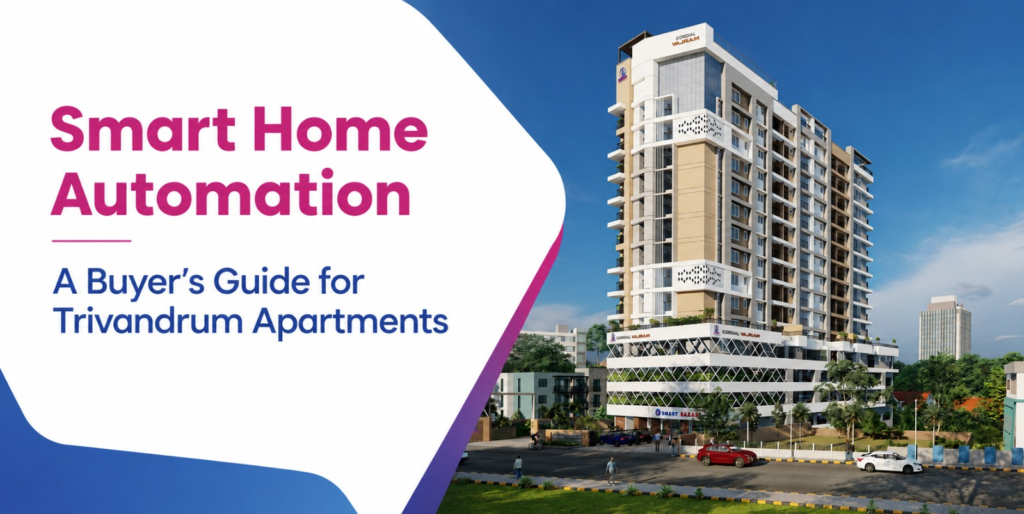
Forward-thinking builders make these provisions during construction, not as optional upgrades later. Cordial Developers, for example, provides conduit and internet connectivity provisions during construction at Vajram and Vivana. That becomes valuable when residents decide to install automation years later.
Why Trivandrum’s Environment Changes Every Calculation
Smart home products are often designed for controlled environments. Trivandrum presents very different operating conditions.
High Humidity
During the southwest monsoon, relative humidity regularly exceeds 85%.
At room temperatures around 22°C, any surface below approximately 19°C can accumulate condensation. This includes:
- PCB traces
- Smart switch modules
- Camera housings
- Sensor enclosures
Over time, moisture leads to oxidation, intermittent failures, and eventual circuit damage. This is not an occasional problem. It is a seasonal reality for unsealed electronic devices.
Power Stability
Voltage fluctuations and short power outages are common across much of Trivandrum.
Any smart device that depends entirely on continuous electricity and internet connectivity is likely to fail when residents need it most.
This makes generator backup extremely important.
Instead of asking whether generator backup exists, ask:
- Does it cover security systems?
- Does it power the intercom?
- Which apartment circuits remain active during an outage?
These answers matter more than the number of smart devices installed.
Water Supply Characteristics
KWA water pressure changes throughout the day.
Smart leak detectors designed for constant-pressure municipal systems can produce false alarms when connected to varying KWA supply pressures.
Projects like Cordial Vajram include individual apartment water meters. Besides enabling fair billing, this creates the foundation for future smart water monitoring systems.
Local Service Availability
Before selecting any smart home product, verify whether it can actually be serviced in Trivandrum.
Questions worth asking include:
- Is there a certified service partner locally?
- Who performs warranty repairs?
- How long does firmware-related service typically take?
Even highly rated products become frustrating if repairs require weeks of waiting.
Feature-by-Feature Evaluation
1. App-Controlled Lighting
Many residents stop using lighting apps within weeks because opening an app simply takes longer than pressing a switch.
What people continue using is automation that removes the decision altogether.
Examples include:
- Lights turning on when someone enters a room
- Colour temperature changing at sunset
- Lights switching off automatically when rooms are vacant
This requires motion sensors and a local automation hub, not just Wi-Fi switches.
If a builder offers app-controlled switches without sensors or a hub, it is essentially a remote control rather than a smart lighting system.
A properly designed system also falls back to manual switch operation during power interruptions.
Typical maintenance includes:
- Firmware updates
- Sensor battery replacement
- Occasional recalibration
Verdict: Worthwhile only when combined with occupancy-based automation.
2. Smart Locks
Among all smart home features, digital door locks consistently deliver the highest long-term usage.
A quality lock should provide:
- Fingerprint access
- PIN access
- Physical key override
- Independent battery operation
Such locks continue functioning without internet connectivity or building power.
Battery life generally ranges between eight and twelve months.
Routine maintenance involves cleaning the fingerprint sensor and occasional recalibration, especially after prolonged exposure to humid conditions.
Verdict: One of the few smart home features worth specifying in the sale agreement.
3. Video Door Phone vs Video Doorbell
These products appear similar but function very differently.
Hardwired Video Door Phone
A hardwired system connects the building entrance directly to each apartment through the building’s intercom network.
Advantages include:
- No internet dependency
- Generator backup support
- Reliable during router failures
- Maintained by the building association
Wireless Video Doorbell
Wireless doorbells depend entirely on cloud connectivity.
Limitations include:
- Internet dependency
- Delay in notifications
- Failure during outages
- Greater exposure to weather damage
If a building already provides a proper intercom system, a wireless video doorbell adds very little practical value.
Verdict: Choose a hardwired video door phone whenever possible.
4. Automated AC Control
The most attractive feature usually sounds like switching on the AC before reaching home.
In reality, this novelty fades quickly.
Long-term value comes from occupancy-based automation that:
- Turns the AC off when rooms are empty
- Restores comfortable temperatures before occupants return
Simple IR blasters cannot determine whether the AC is already on or what operating mode it is using.
Verdict: Worth considering only with intelligent occupancy-based control.
5. Smart Plugs and Energy Monitoring
Standalone smart plugs generally see low long-term usage.
A better investment is panel-level energy monitoring, where electricity consumption is tracked by circuit from the apartment’s electrical panel.
This provides:
- More meaningful consumption data
- Whole-home visibility
- Better long-term energy insights
Projects incorporating solar infrastructure and individual apartment metering make these systems even more useful.
Verdict: Prioritize building-level infrastructure over individual smart plugs.
6. Building Security Integration
Security is infrastructure, not simply another smart feature.
A properly integrated system connects:
- Building entrances
- CCTV
- Lift access
- Gate barriers
- Security cabin
- Apartment intercom
The most important question is not how many components exist.
Instead ask:
Which of these continue working during a power outage?
Redundancy matters far more than marketing brochures.
Verdict: Essential infrastructure.
7. Voice Assistant Integration
Voice assistants depend entirely on internet connectivity.
During power failures they become unusable.
Other common issues include:
- False activations
- Wake-word conflicts
- Background noise
- Privacy concerns
For many households, they eventually become expensive Bluetooth speakers.
Verdict: Not worth specifying in a new apartment.
8. Automated Curtains and Blinds
Motorized curtains provide genuine value only in specific situations, such as:
- Large balcony doors
- High windows
- West-facing apartments with heavy afternoon sun
Before purchasing, verify:
- Manual override
- Motor replacement cycle
- Maintenance requirements
Verdict: Useful only where manual operation is genuinely inconvenient.
What to Verify During a Site Visit
A completed apartment should allow you to inspect the following:
Electrical
- Neutral wire inside every switch box
- Separate low-voltage conduit
- Future capacity in the electrical panel
Digital Door Lock
- Test the physical key
- Confirm operation without batteries or internet
Smart Systems
Ask which systems continue operating without internet connectivity.
Video Door Phone
Test:
- Audio clarity
- Video quality
- Generator backup operation
Security
Ask whether these remain operational during outages:
- CCTV
- Biometric access
- Intercom
- Gate barrier
Request the generator load schedule if possible.
Maintenance
Ask who provides post-handover smart home service and confirm they have a local presence in Trivandrum.
Where This Lands
Specify During Purchase
These are infrastructure decisions that are expensive or difficult to retrofit later.
- Digital door lock with physical key override
- Hardwired video door phone integrated with the building intercom
- Neutral wiring and conduit at every switch point
- Panel-level energy monitoring
- Individual apartment water metering where KWA compliant
Install After Possession
Only after understanding how you actually use the apartment.
- Occupancy-based lighting with sensors
- Smart AC automation
- Motorized curtains for large west-facing openings
Skip Entirely
Avoid spending money on:
- Standalone smart plugs as your primary energy monitoring solution
- Voice assistants
- Wireless video doorbells when a wired intercom already exists
- Any system that depends entirely on continuous internet connectivity
Conclusion
Not every smart home feature deserves equal attention or investment.
Infrastructure such as proper wiring, conduit, integrated security systems, reliable intercoms, and future-ready electrical panels will continue adding value long after newer gadgets become outdated.
Builders who present voice assistants alongside biometric access systems as equally important “smart” features are highlighting a specification sheet rather than a thoughtfully designed home.
The real difference becomes obvious during the first monsoon power outage, when reliable infrastructure continues working and cloud-dependent gadgets stop functioning.
Recent Posts


The Right Address Never Waits for
Most conversations about apartment investment in Trivandrum default...
Read More
Ready to Find Your Home?
Book a Visit to Cordial Developers
Our advisors will arrange a personalised site tour at your convenience and guide you through pricing, floor plans, and payment options.

Luxury flats in Trivandrum
Member of :


© 2026 Cordial Developers Pvt. Ltd. All Rights Reserved. · RERA Registered.
Crafted by Medowa Global