
Solar, EV Charging, and Energy Management at Cordial Vivana: What the Infrastructure Actually Saves You
Cordial Vivana is currently under construction at Pallippuram, near Technopark Phase 4, and work is progressing quickly. That pace matters for a specific reason: several of the infrastructure decisions this note covers, solar system sizing, generator circuit allocation, EV panel provisioning, are made or locked in during construction, not after. If you’re evaluating Cordial Vivana as a purchase, this is the right stage to understand what’s being built into the project and what questions to raise with the sales and construction team before you commit.
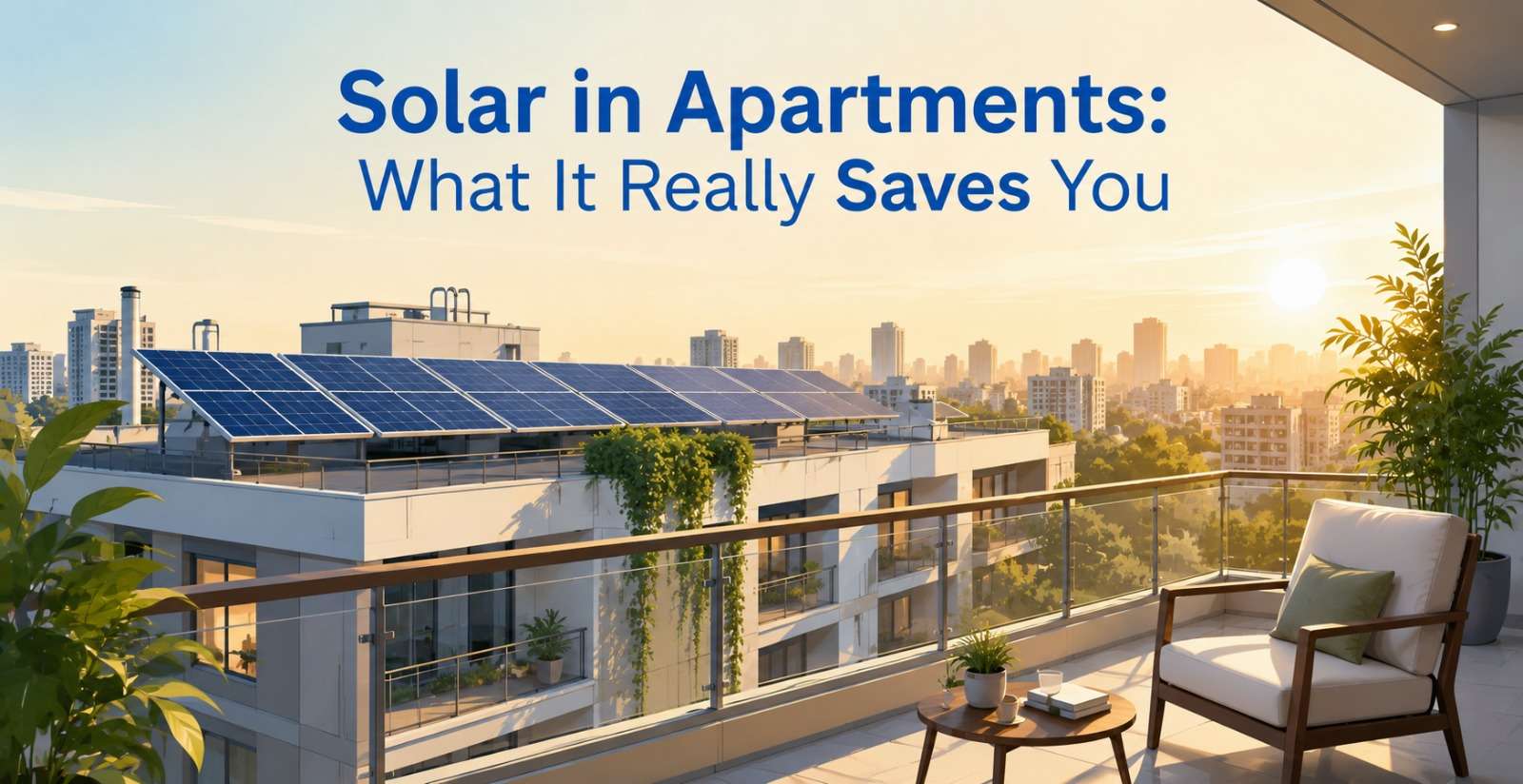
Most apartment buyers hear “solar provision” and picture a lower personal electricity bill. The bill they have in mind is the one KSEB sends to their own apartment every month. In a multi-unit residential building, that is not how it works, and understanding the difference between solar in a standalone house and solar in a twelve-floor apartment complex is the starting point for evaluating this project’s energy infrastructure honestly, while it’s still being built.
Cordial Vivana, Cordial Developers’ 135th project, specifies on-grid solar support provision at the terrace level, EV charging provision in each apartment’s electrical panel board, a Sewage Treatment Plant, a Water Treatment Plant, generator backup across key building loads, and a bio-bin food waste management system. This note explains what each of these commitments actually means for your running costs and your Owners Association’s obligations once you move in, and what to verify now, while the building is still going up.
How On-Grid Solar in an Apartment Building Actually Works
In a standalone house, rooftop solar feeds directly into the home’s consumer meter. The household uses what the panels generate during daylight hours and imports from KSEB when generation falls below demand. Net metering tracks the export-import balance and adjusts the bill accordingly.
In a multi-unit residential building like Cordial Vivana, this architecture does not apply in the same way. The building has one common service connection, a single electricity meter under which all shared loads run, and dozens of individual apartment meters, each registered to a separate consumer. The rooftop solar system, once commissioned, will connect to the common service connection, not to individual apartment meters.
This means Cordial Vivana’s solar provision will offset the building’s common area electricity bill, not any individual resident’s domestic electricity bill. The practical consequence: solar generation reduces the cost of powering shared infrastructure, and that reduction reaches residents as lower maintenance charges after possession, not as credits on personal KSEB bills.
This is not a weakness of the design; it is the correct and legally straightforward implementation of apartment solar under India’s current regulatory framework. The common service connection is a single consumer entity, the maintenance committee during construction, and the Owners Association after handover, and it is against this entity’s account that the KSEB net metering agreement is executed.
Under the KSERC Renewable Energy Regulations 2025 (effective November 6, 2025, with billing from January 1, 2026), net metering for common service connections in multi-storey residential apartments is permitted up to 500 kW, and systems up to 10 kW are exempt from grid support charges. Surplus exported units carry forward to the next billing cycle rather than being paid out in cash, so summer generation and monsoon shortfalls smooth out over a twelve-month settlement once the system is live.
Why the Common Area Load at Cordial Vivana Makes Solar Worth Watching
The financial case for solar on a common service connection depends on how large that connection’s electricity bill will actually be. A building with minimal shared amenity has a thin common bill and correspondingly modest solar savings. Cordial Vivana’s specified amenity list points to a substantial common area load once the building is operational, and therefore a meaningfully larger opportunity for solar to offset it.
Based on the specification, these load categories will sit on the common service connection:
Water systems: The swimming pool with toddler’s pool, the sewage treatment plant, the water treatment plant, the building’s bore well and sump/overhead tank water supply system feeding all floors, and garden and car wash water supply. Water pumping is typically the single largest common area electricity load in a multi-storey building, often 30 to 40 percent of the total common bill. Variable frequency drives on pump motors can reduce this load significantly where specified, worth asking about, since the brochure doesn’t confirm VFDs as part of the current spec.
Vertical transport: Three lifts are specified, one passenger lift, one bed/fire lift, and one service lift, each with an Automatic Rescue Device (KONE/Johnson or equivalent), running continuously across twelve floors once installed. Elevator systems are typically the second largest common area electricity load in high-rise buildings.
HVAC and comfort: The AC lobby with furnished reception area, the AC indoor games room, the AC multipurpose hall with balcony, and the fully equipped gym with a music system will all run on the common connection as sustained, not intermittent, loads.
Security and operations: CCTV at designated areas, 24/7 security, biometric access control at the lobby and designated entrances, an automatic gate/boom barrier system, and corridor lighting across twelve floors.
Outdoor infrastructure: The walking/jogging track, the basketball court, the outdoor barbeque area, the rooftop terrace/view point area, and designated car wash points.
Together, this is a substantial monthly common area electricity bill once the building is fully occupied and running, and it’s against this bill that the on-grid solar provision will work. The terrace location keeps the array above the building’s shadow profile, maximising the daily generation window.
What’s Committed So Far and What to Ask While Construction Is Ongoing
Cordial Vivana’s brochure specifies on-grid solar support provision at the terrace level, “as per relevant building rules.” This confirms the type of system (on-grid, net-metered) and the location (terrace), but it does not state a KVA capacity. Since the building is still under construction, this is exactly the window in which capacity decisions get finalised, which makes it a live question, not a historical one.
As a general benchmark, every 1 kW of installed solar capacity needs roughly 60 to 100 square feet of shadow-free roof area and generates approximately 120 to 140 kWh per month under typical Kerala solar irradiance. For a building of Cordial Vivana’s scale, the practical capacity ceiling is set by the shadow-free terrace area left over after lift machine rooms, water tanks, fire escape access, and maintenance walkways, typically 40 to 65 percent of nominal rooftop area.
If you’re evaluating Cordial Vivana now, ask directly: what KVA capacity is planned or already registered with KSEB for technical feasibility, and at what stage that approval process currently stands. Getting this answer during construction, rather than after handover, gives you a real basis for estimating future maintenance savings, not a vague promise.
KSERC 2025: The Regulatory Framework Behind the Numbers
The Kerala State Electricity Regulatory Commission’s 2025 Renewable Energy Regulations changed how net metering works for new installations statewide, effective November 6, 2025, with the revised billing system live from January 1, 2026.
For common service connections in multi-storey residential apartments, the regulations permit net metering up to 500 kW, a generous ceiling for any building currently under construction in Trivandrum, including Cordial Vivana. The real constraint is available roof area, not the regulatory cap.
Individual flat meters do not currently receive automatic proportional credits from a shared rooftop plant. The common service connection receives the net metering benefit. Virtual Net Metering, which would allocate credits proportionally to individual flat meters, exists in the regulatory architecture but awaits detailed implementation guidelines from KSEB.
For a Cordial Vivana buyer, this means the solar benefit will reach you through reduced maintenance charges after the Owners Association is formed and the net metering agreement is registered, not through credits on your personal KSEB bill. The developer is required to form the Owners Association within six months of possession, with Cordial Care facilitating that process. That handover point is when the institutional framework for managing solar savings gets established, so it’s worth understanding now, before you’re relying on it.
EV Charging: What the Provision Means While the Building Is Still Going Up
Cordial Vivana’s brochure specifies EV charging provision in the electrical panel board for each apartment, plus common electric car charging points for three visitor car parks on a chargeable basis.
“Provision in the electrical panel board” means the electrical design has accommodated the additional circuit capacity and conduit pathway EV charging needs, this is the kind of thing that’s far cheaper and easier to build in now, during construction, than to retrofit later. The charger hardware itself (the wall box or charging column) is not necessarily installed at possession. Activating EV charging at your slot later will require the charger hardware, an electrician, and a KSEB application for additional sanctioned load, the brochure notes this is contingent on prevailing KSEB rules and technical feasibility, and comes at extra cost to the owner.
In a building not designed with this provision, the same activation later would mean opening the electrical panel, running new wiring through finished surfaces, and potentially a structural KSEB application, a meaningfully more disruptive and costly process. Cordial Vivana’s approach avoids that.
In Trivandrum’s premium apartment market in 2026, EV provision is increasingly a baseline expectation, though it’s still a minority feature across the city’s active inventory. For a medium-term horizon, it protects resale value as EV charging becomes a standard tenant requirement.
STP, WTP, and the Infrastructure Being Built In
Cordial Vivana’s Sewage Treatment Plant and Water Treatment Plant are part of the base construction specification, not optional add-ons. In a building of this scale at Pallippuram, the STP is a requirement under Kerala State Pollution Control Board norms for multi-storey residential buildings above a specified unit count, meaning it’s being engineered in now, alongside the structure itself.
Getting this right during construction matters because a poorly functioning STP after handover becomes a compliance liability that lands on the Owners Association, and by extension, on every resident through special assessments or disrupted services.
The STP and WTP also create a water recycling pathway: treated effluent can be used for garden irrigation and car washing on the premises. Cordial Vivana’s brochure specifies bore well and sump tank water supply with automatic pumping as the building’s water arrangement (individual apartment water metering is a separate, extra-cost provision contingent on prevailing KWA rules), so this recycling benefit is best understood as reduced draw on the building’s own bore-well/groundwater supply, not on municipal KWA water.
Both the STP and WTP draw on the common service connection, which means they’re part of the load the solar system will offset once commissioned.
The bio-bin food waste system rounds out the waste picture, on-site aerobic composting of organic waste, reducing what goes to municipal collection and producing compost usable in the building’s landscaping.
The Complete Picture, As It’s Being Built
Generation: On-grid solar at the terrace, once commissioned, will offset the common service electricity bill, with surplus units banked under KSEB’s net metering framework.
Backup: Generator backup is specified for lifts, water pumps, common lighting, and designated points in each apartment, up to 1,300 watts per apartment (excluding AC and power plug points), enough for essential lighting, a fan, and phone charging during a monsoon outage.
Future-ready infrastructure: EV charging provision per apartment panel board, plus three common visitor charging points, is being built into the electrical design now rather than retrofitted later.
Waste and water: STP, WTP, and bio-bin management close the resource loop at the building level as part of the core construction scope.
Once the building is complete and occupied, this infrastructure’s financial effect on residents flows mainly through the maintenance charge: lower common electricity costs from solar, avoided penalty risk from STP compliance, lower fuel costs from an efficient generator spec, and avoided retrofit costs from the EV provision.
What to Ask Before You Book, While the Building Is Still Under Construction
This is the stage where asking pays off, because several of these answers are still being finalised on-site.
Solar capacity: What KVA capacity is planned or has been registered for KSEB technical feasibility, and at what stage is that approval process right now?
EV activation process: What’s the process and estimated cost for activating EV charging at your specific parking slot after possession, does it need a KSEB sanction amendment, and who manages that process?
Generator circuit scope: Is the building’s network infrastructure (comms room, intercom system, CCTV recording equipment) included on the generator circuit? These are the systems whose uptime matters most for security during an outage.
HOA and solar management: How will the net metering agreement be registered and managed after the Owners Association forms, how will solar savings be distributed through the maintenance fee structure, and what’s the plan for an Annual Maintenance Contract covering panel cleaning? Dust and monsoon buildup can meaningfully cut panel output within a couple of months without regular cleaning.
Construction and possession timeline: Since Cordial Vivana is actively under construction, ask for the current construction stage, the RERA-registered expected completion date, and how that aligns with the specific floor and unit type you’re considering. This is verifiable directly at rera.kerala.gov.in under K-RERA/PRJ/TVM/032/2026.
The Assessment
Cordial Vivana’s energy infrastructure specification is coherent and internally consistent, the solar provision, EV infrastructure, STP, WTP, generator backup, and bio-bin management form an interconnected system rather than a checklist of unrelated amenities, each addressing a real operational requirement for a twelve-floor residential building at Pallippuram.
Because construction is progressing quickly, the practical decisions that turn this specification into real savings, solar KVA sizing, generator circuit allocation, EV activation logistics, are being made now. That’s exactly why this is the right moment for an aspiring buyer to ask pointed questions rather than wait until after possession.
The financial benefit for residents, once the building is complete, will flow through the maintenance charge structure rather than through individual electricity bills. Buyers who understand this mechanism can evaluate the specification honestly; buyers who expect a direct personal electricity bill reduction will misread what the infrastructure delivers.
For a building at Pallippuram, adjacent to TCS’s Digital Hub, the Kerala Space Park, and Digital University Kerala, this infrastructure isn’t peripheral to the value proposition. It’s central to what should make the running cost of living at Cordial Vivana structurally different from a comparable apartment at a less thoughtfully specified, or less carefully verified, address.
See the Construction Progress for Yourself
Because Cordial Vivana is under active construction, a site visit right now shows you the real thing, the pace of work, the terrace area being prepared for solar, the electrical rough-in for EV panel provisions, rather than just artistic renderings. Cordial Developers’ team at Pallippuram can arrange accompanied site visits; use that visit to ask the five verification questions above directly, on-site, where the answers are most concrete.
For NRI buyers or those evaluating remotely, Cordial Developers can be contacted to arrange the full specification and floor plan set, along with construction progress updates. Cordial Care handles the complete inquiry and post-purchase process, from documentation support and home loan assistance to rental management and HOA formation after possession.
Recent Posts

2 BHK Apartments near Technopark: How
For someone who works at Technopark or Technocity,...
Read More
Best Apartments near Pallippuram: What to
Pallippuram has moved from a quiet highway stop...
Read More
Ready to Find Your Home?
Book a Visit to Cordial Developers
Our advisors will arrange a personalised site tour at your convenience and guide you through pricing, floor plans, and payment options.

Luxury flats in Trivandrum
Member of :


© 2026 Cordial Developers Pvt. Ltd. All Rights Reserved. · RERA Registered.
Crafted by Medowa Global